Risks of Using Closed-Source AI for Your Business
Are you trusting your business to a "black box"? Discover the hidden dangers of relying on closed-source AI models in 2025, from vendor lock-in to data privacy risks.
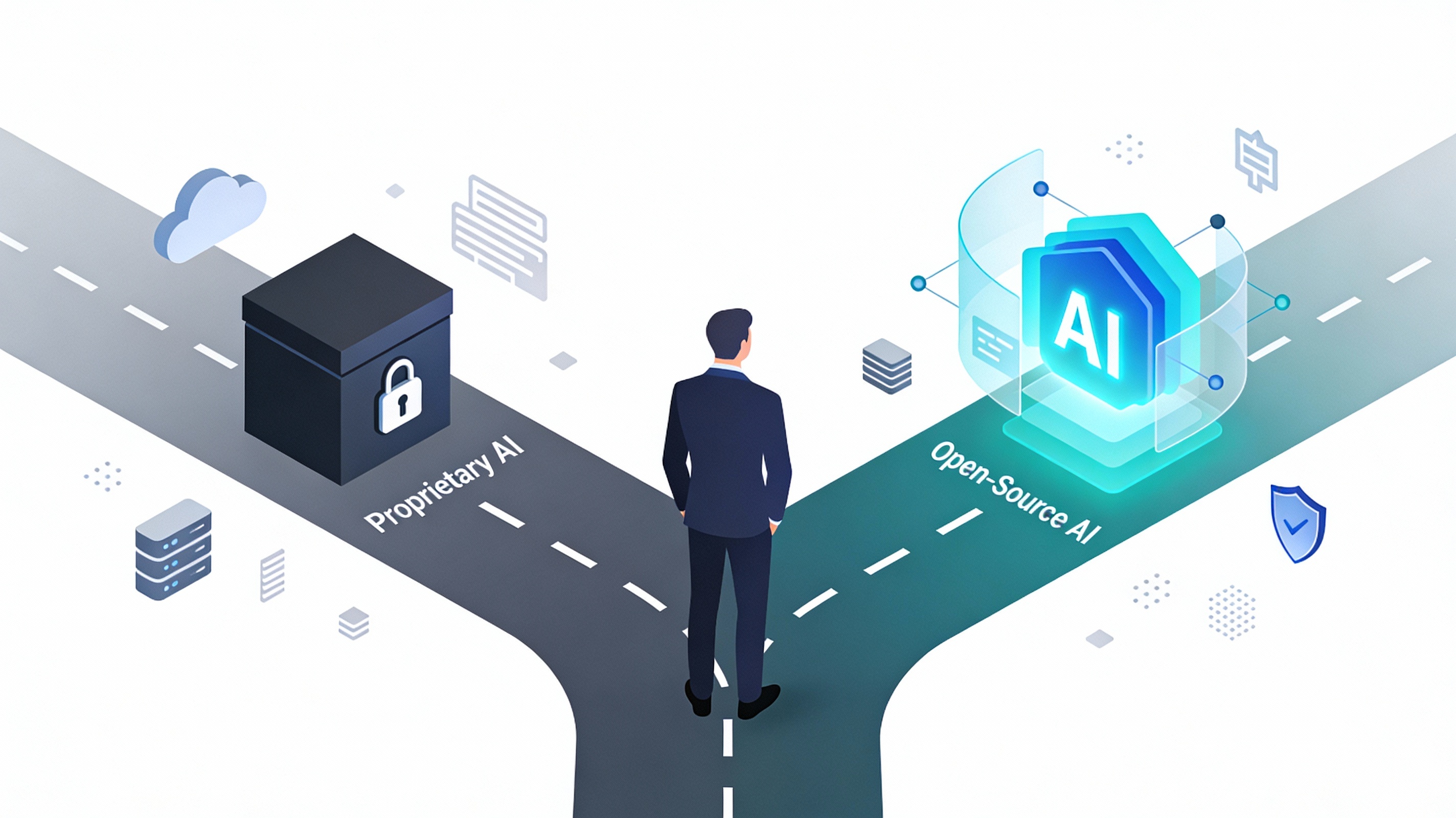
In the fast-paced world of AI, the path of least resistance is often a proprietary API. It’s easy: you sign up, get an API key, and suddenly your product has "AI capabilities." But for businesses building their future on this technology, the convenient choice often carries hidden, long-term costs.
Relying entirely on closed-source AI (like proprietary chatbot APIs) introduces structural risks that can threaten your company's agility, security, and bottom line. Here are the three fundamental dangers every business leader needs to understand in 2025.
Business choosing between closed-source and open-source AI 2025
1. The "Vendor Lock-In" Trap
When you build your product on top of a closed API, you aren't just a customer; you are a dependent. You are building your house on rented land.
- Policy Drift: In 2025, we've seen major vendors abruptly change their "safety filters," suddenly breaking legitimate use cases for business customers overnight. If your AI provider decides your industry is now "high risk," your product stops working.
- Pricing Power: Once your workflow is integrated with a specific proprietary model, switching costs are high. Vendors know this. They can raise prices, and you have little choice but to pay.
- The Open Alternative: With open-source models like Llama 4 or Qwen 3, you own the model weights. You can host them on AWS, Azure, or your own basement server. No one can evict you from your own intelligence.
2. Data Privacy & The "Black Box" Problem
One of the most trending topics in enterprise IT is "AI data sovereignty." When you send a prompt to a closed model, your data traverses the public internet and enters a server you cannot audit.
- The Trust Deficit: You have to rely on the vendor's promise that they aren't training on your data. But terms of service change, and bugs happen. In highly regulated industries like finance, healthcare, or law, "trust us" is not a compliance strategy.
- The Open Alternative: Hosting an open-source model on-premise means your data never leaves your firewall. You can process sensitive medical records or financial data with mathematical certainty that it isn't leaking to a third party.

3. Stagnation vs. Customization
Closed-source models are "generalists." They are trained to be pretty good at everything, from writing poetry to coding Python. But businesses rarely need a generalist; they need a specialist.
- The "Good Enough" Ceiling: You generally cannot modify the weights of a proprietary model. If it doesn't understand your company's internal jargon or specific coding style, you are stuck with prompt engineering to try and fix it.
- The Open Alternative: Open-source models allow for fine-tuning. You can take a base model like DeepSeek-V3.2 and train it further on your own documents. This creates a smaller, cheaper, and faster model that outperforms the massive generalist models on your specific tasks.
Conclusion
Closed-source AI is a powerful tool for prototyping and casual use. But for a core business function, it introduces risks dependency, opacity, and lack of control that are becoming harder to justify in 2025.
By choosing Open Source, you are choosing independence. You are building an asset you own, rather than renting a service that can be taken away.